Jordan Luplow is doing the good stuff

Whether it’s a purposeful change or just the result of a good process, Jordan Luplow is a bit different than his previous Pokémon forms. Those alterations to his hitting profile have resulted in six homers in the season’s opening month, a team-high 175 wRC+ (100 is league average) and the walk-off bomb to the bleachers that lifted Cleveland to a victory over the Twins on Monday night and earned him a run-by pie.


Tasty.
Let’s start with the obvious: He’s launching the ball in the air more than ever before. Of course, that’s hardly a new idea. In fact, it’s been mocked enough on national broadcasts to make even the biggest stat nerd roll their eyes at the mention of launch angle. But while the idea of hitting the ball in the air is often oversimplified — it might not be for every batter — if you’re looking to add slugging, it comes in the air.
Luplow’s average launch angle this year is a career-high (28.6), up nearly four degrees from last year, his previous high. His percentage of balls hit on the ground (26.5%) is well down from his career norms (38.25). But as we saw with Jason Kipnis, sometimes simply elevating more doesn’t lead to intended results, particularly if you’re not hitting the ball at an exit velocity that leads to more distance.
Think of it like this: if you add more loft to those soft line drives that often land between the infielders and outfielders, they become easy pop outs. But if you hit the ball harder, those balls tend to find gaps, clear fences and generate those highly-coveted barrels - Statcast’s ideal combination of exit velocity and launch angle.
Lucky for Luplow, the exit velocity (89.6 mph) is up 6.1 percentage points from last year and on par with when he was living rent-free in the head of every southpaw during the 2019 campaign. More important, though, the percentage of balls that he is hitting at 95 mph or harder (Statcast calls this hard-hit rate), has never been higher. His hard-hit rate (41.2%) is up over 16 percentage points from last year and two percentage points from when things went well in 2019.
We should note, however, that Luplow’s exit velocity and hard-hit rate don’t necessarily stand out on their own. Both are slightly over league average. But when paired with his higher launch angle, it’s almost as if Luplow is trading chances at some seeing-eye singles and bloop base hits — things that can sometimes raise the batting average — for a greater opportunity to barrel the ball and drive it.
If that’s the goal, it’s paying off. While Luplow’s expected batting average is right in line with his actual batting average (.229), his barrel rate is in the 91st percentile in baseball. His barrel per plate appearance rate ranks him 21st among hitters with 25 batted-ball events, slightly ahead of sluggers like Aaron Judge and Giancarlo Stanton. And why do we care about barrels? Well, those are the batted balls that typically lead to extra-base hits, homers and dramatically change games.
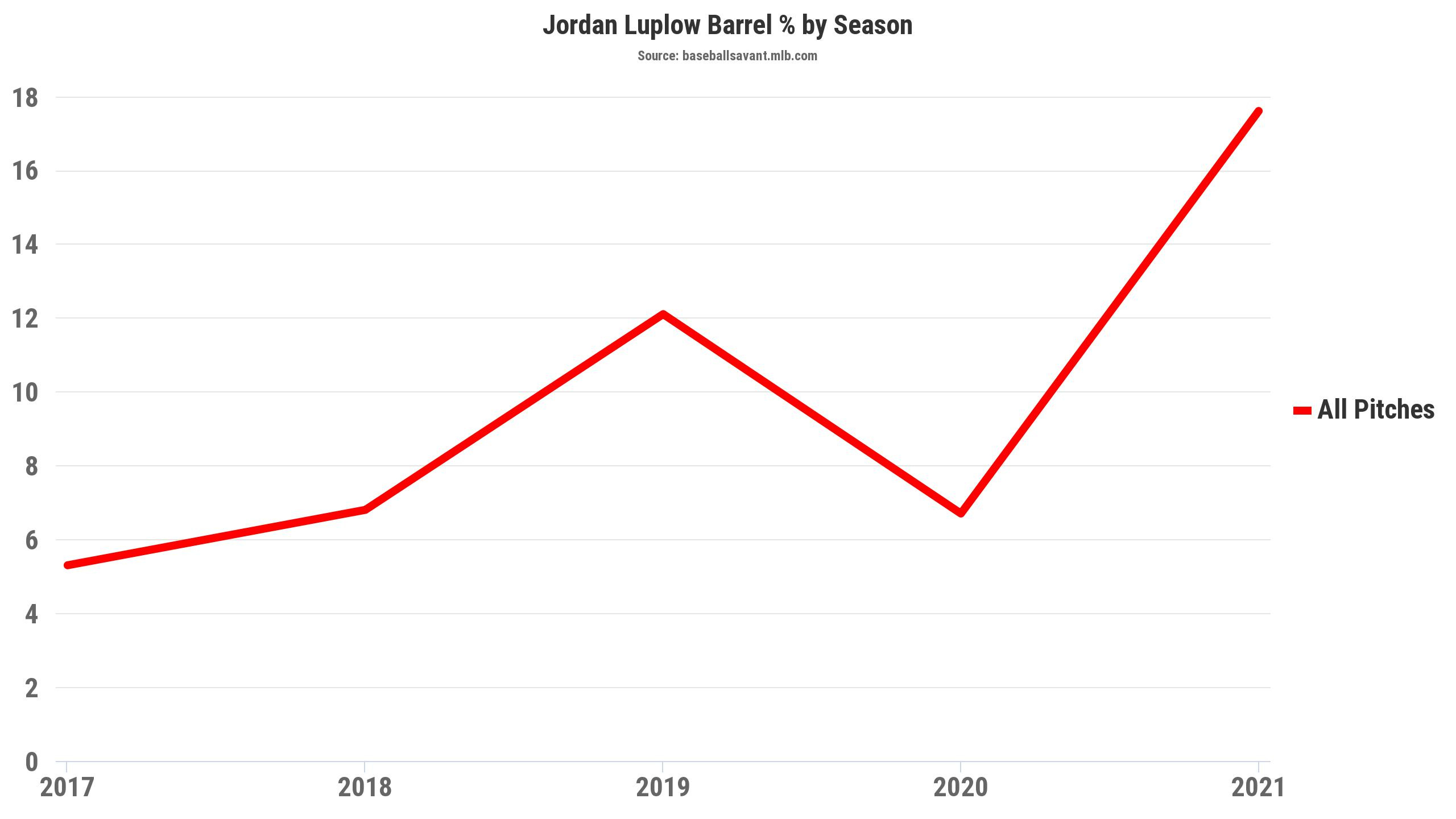
Those types of hits are even more impactful when considering how difficult it has been for Cleveland to string together multiple hits in 2021. While that may mean fewer singles, Luplow has been drawing walks at a 14.3 percent clip, so his on-base percentage is an acceptable .339. And do you care about singles if he’s still getting on base and his contact does a tremendous amount of damage?
We could stop there and be somewhat fulfilled.
After all, the average distance of his fly balls is at 342 feet, way up from last year (296 feet) and slightly up from 2019 (336 feet). Mission accomplished, right?
That’s great, but the bigger question about Luplow has always been his ability to survive against righties, and it has been the right-handers that he’s been clobbering to the tune of a 1.142 OPS. But we’re talking about 20 plate appearances in 2021 (and some OK success against them in the minors) compared to a Major League career filled with scuffles against the platoon disadvantage. The only thing that will give us a better understanding of Luplow’s ability is time.
(For a deeper dive on the potential reasons for those struggles — that includes a look at some location and pitch type differences — I suggest checking out Matt Lyons’ piece over at Covering The Corner.)
But we can probably get a better understanding of the process that has led to better results by digging some into his approach. One of the first things that stands out in deep red over at Luplow’s Baseball Savant page is his elite chase rate in 2021. He’s ability to spit on pitches outside the zone is in the top four percent of baseball this year. Yes, his strikeout rate (25%) is above his career norm (22.4%), but that isn’t the result of frequently chasing junk outside the zone — and in fact, it may suggest that he’s just taking more chances on his swings to load up and drive the ball.
His swing-take profile at Baseball Savant gives us a good idea of how well he’s been able to force his swings to where he can do the most damage, the heart of the plate.
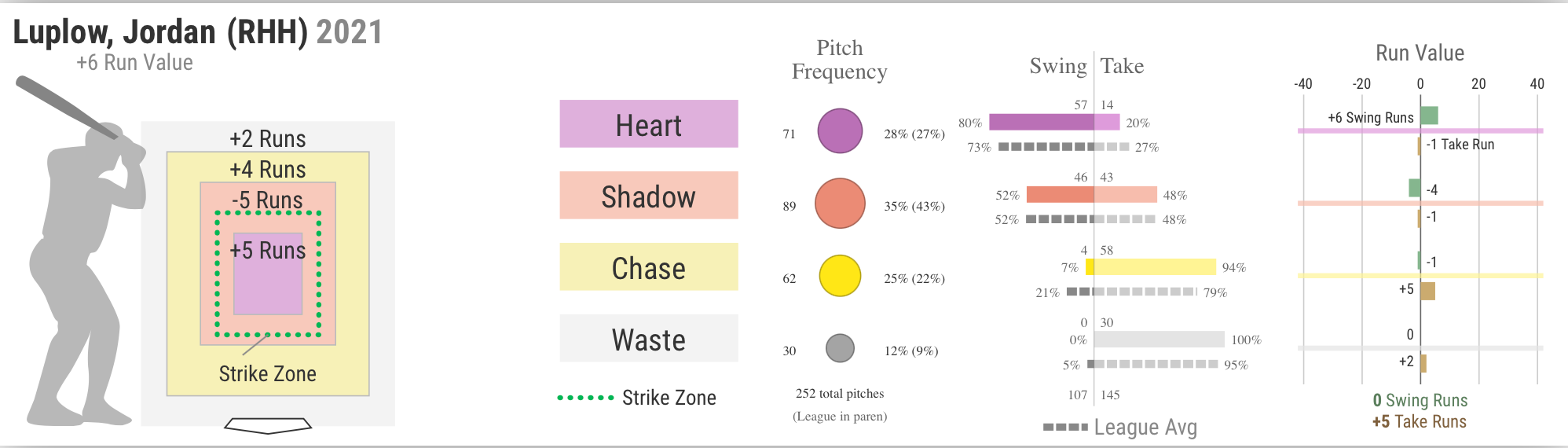
The league average swing rate on pitches to the heart of the plate is 73 percent. Batters are hitting .297 with a .538 slugging percentage in that zone so far this year. Luplow is swinging at 80 percent of the pitches there, hitting .333 with a 1.083 slugging percentage (yes, that’s SLUGGING) in that zone. Meanwhile, he’s yet to swing at anything in the waste zone and taking just four swings in the chase area.
He’s not doing pitchers any favors.
So, when we take into account that Luplow is taking more cuts when the pitch is in the damage zone and apparently looking to pulverize the ball when it arrives, we can see why he’s evolving. But how will the pitchers adjust?
To Luplow’s credit, he’s done a better job of hunting the right pitches and avoiding the ones in which he struggles. Throughout his career, he’s had better luck driving “fastballs” and “breaking” pitches than offspeed (changeups).
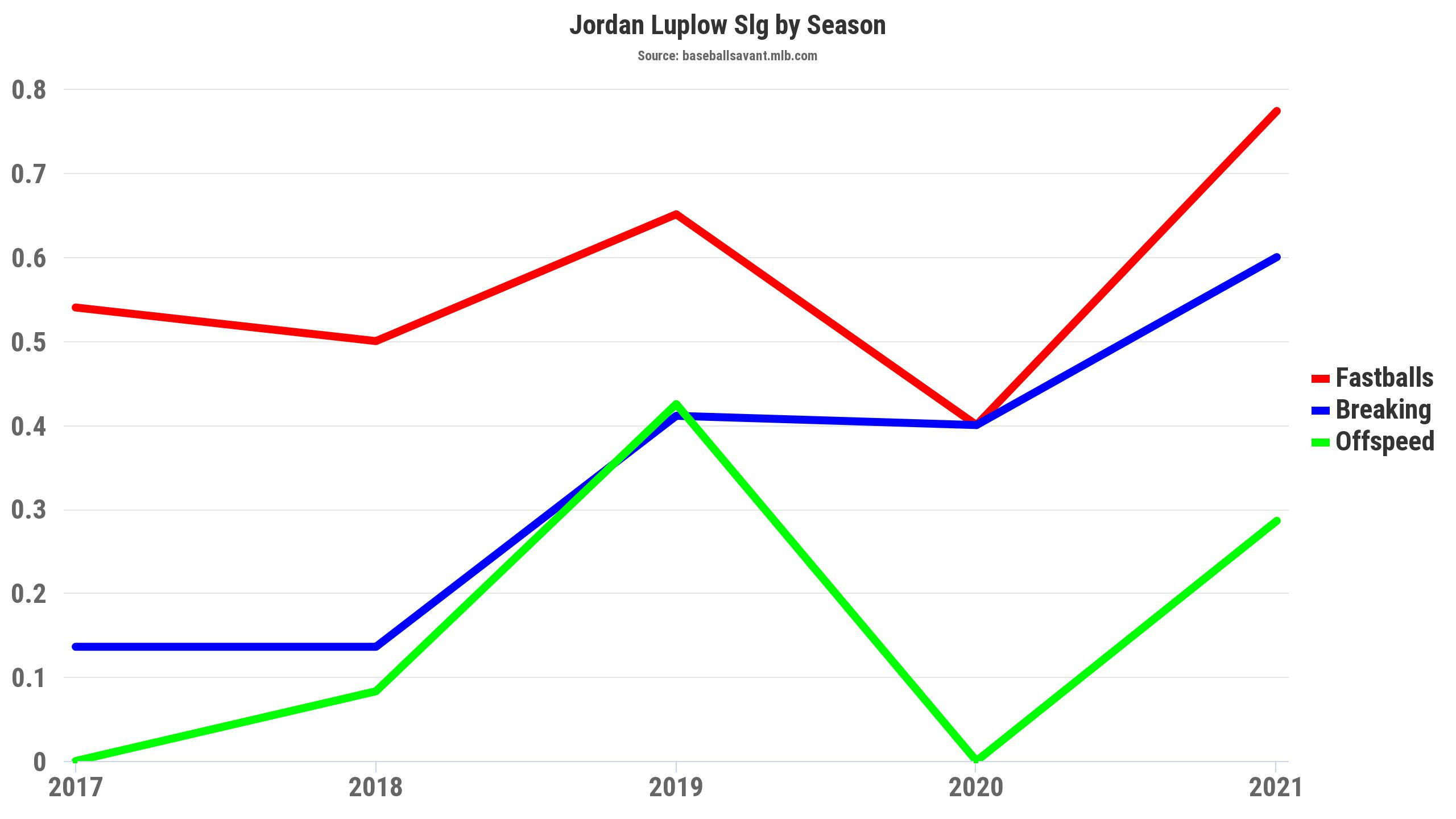
If those struggles are anything more than random noise, he’s done a decent job in remedying it by swinging at fewer of the offspeed pitches he’s seen this season.
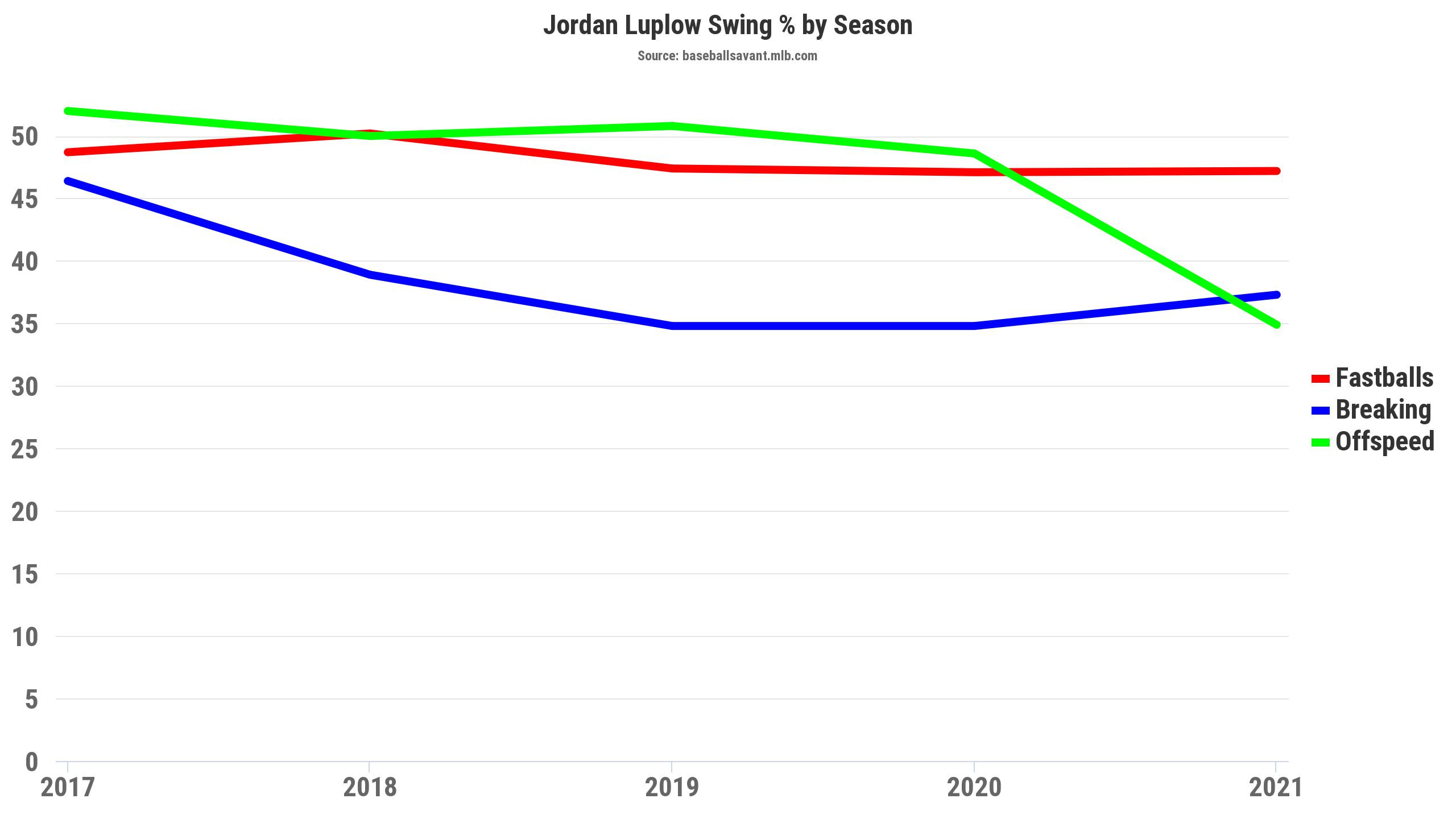
Theoretically, if he’s disciplined enough to lay off the soft stuff out of the zone, it will lead to more favorable counts and a necessity to keep the hard stuff on the menu. But can that continue at an elite rate? Who knows?! There is never any finality on this sort of stuff. As is largely the case with any player, if the process remains in place, the results may follow. If Luplow fails to remain as diligent with his chase rate or doesn’t take advantage of hittable pitches, his production could dip.
The same can be said for his launch angle and exit velocity. If he fails to hit the ball as hard, all of those weak fly balls aren’t going to do anyone any good.
But nothing about an 88th percentile expected slugging mark or 80th percentile expected weighted on-base average (based on quality and frequency of contact mixed with walks - you know, the good stuff) suggests Luplow has lucked into a few homers.
Even Statcast’s expected homers metric says he’s essentially earned all six trips around the bases. What it says, however, about earning a face full of shaving cream, is unclear.
Fantastic analysis! Keep 'em coming on here!
Excited to see you here on Substack. Looking forward to the Tribe analysis.